There is currently a scare going around on Facebook and in emails stating that a Facebook application titled "Fan Check" is actually a virus that will activate after 48 hours even if you were tagged in a photo on someone else's profile. While the jury is still out on whether Fan Check is actually malicious, the greater risk comes from doing a search on the phrase '"Facebook Fan Check Virus" as you might be directed to a website containing fake antivirus software that will actually install a real virus or otherwise try to trick you out of your money. For an example of one of these sites watch the video below.
According to an article on Mashable the Fan Check app is most likely just a broken application that wont work because it violates Facebook's policies. Your safest bet is to stay away from Fan Check or any other application that claims that it can tell who's been viewing your profile, and definitely DO NOT search for “Fan Check Facebook virus”. If you are concerned that you have a virus or spyware scan your computer with trusted software. Do not install or scan your computer with any software that you are not familiar with or that you have not checked out thoroughly. Personally I use Spybot S&D, Adaware, and AVG Antivirus,
Showing posts with label Ad-Aware. Show all posts
Showing posts with label Ad-Aware. Show all posts
Monday, September 14, 2009


Monday, August 18, 2008
Anti-Spyware Saves Your Private Information
In an effort to protect users from themselves, most Anti-Spyware programs create backups of the very things they're supposed to delete. Now, I'm definitely not saying that you shouldn't use Anti-Spyware, far from it in fact. I can't begin to tell you how many times that Ad-Aware SE or Spybot S&D have saved my bacon. Many of these programs delete more than just spyware, they attempt to help you protect your privacy by deleting many of the "Recent" lists that Windows stores such as documents that you have recently opened or web pages you've visited. Many Anti-Spyware programs also delete cookies.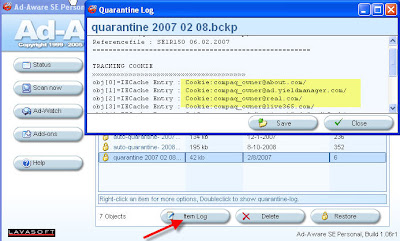
However: To keep users from accidentally deleting an important file or list (Let's face it, how many users really know what is safe to delete?) most of the programs store the information that they are "deleting" in a quarantine file, which is another nice way of saying, "You thought you deleted those files but we really backed them up so they can be retrieved later." Again let me say that Anti-Spyware programs are a GOOD thing, but there are some things most users don't realize, and the quarantine file is a biggest one. This is not a huge problem: the file is easily emptied and you can also tweak the program's settings to not store the files or to store them for a limited period of time. The problem is that many users won't know to change the settings or delete the file themselves. Many people may not even care, but for those of you who are concerned about your privacy, you should take the time to look into your particular program's settings, to see what is saved and what you can do about it. The only thing worse than being paranoid is having a false sense of security.

However: To keep users from accidentally deleting an important file or list (Let's face it, how many users really know what is safe to delete?) most of the programs store the information that they are "deleting" in a quarantine file, which is another nice way of saying, "You thought you deleted those files but we really backed them up so they can be retrieved later." Again let me say that Anti-Spyware programs are a GOOD thing, but there are some things most users don't realize, and the quarantine file is a biggest one. This is not a huge problem: the file is easily emptied and you can also tweak the program's settings to not store the files or to store them for a limited period of time. The problem is that many users won't know to change the settings or delete the file themselves. Many people may not even care, but for those of you who are concerned about your privacy, you should take the time to look into your particular program's settings, to see what is saved and what you can do about it. The only thing worse than being paranoid is having a false sense of security.
Subscribe to:
Posts (Atom)