Showing posts with label privacy risk. Show all posts
Showing posts with label privacy risk. Show all posts
Friday, July 23, 2010
RFID Security Breech Credit Card
The tin foil hat brigade was onto something, just cut a piece of aluminum foil 3 to 4 times the height of your wallet then fold it to the appropriate size and put it in the bill compartment. To test it out place your wallet (must have an RFID equipped card inside) next to the appropriate type of scanner (credit card, bus pass. etc) if it beeps the foil isn't thick enough. If it doesnl't beep you should be ok.


Tuesday, September 15, 2009
Military Recruiters Sharing Information About Your Kids Without Permission
The Department of Defense is maintaining a "Joint Advertising and Market Research Studies" Recruiting Database of over 30 million Americans between 16 and 25 years old. Huge exemptions to federal privacy laws leave it wide open for the DOD to disclose your kid's personal information without your permission! Go to the EPIC website for more information on the DOD Recruiting Database. If that's not enough, recruiters are at your child's school and recruiting your children without your permission. You have to opt out to keep them from actively recruiting your child. At my high school we had a recruiting station in one corner of the library with lots of pamphlets and brochures and once in a while a member of one of distinguished members of our Armed Services would be available to talk to any kid who was interested. I have absolutely no problem with that, What I do have a problem with is situations like the one described on MotherJones.Com. Where a young man was aggressively targeted by recruiters possessing information that he did not give them. I support all of our men and women in our Armed Forces and believe that military experience can be invaluable to many young people, but whatever happened to the old fashioned way of recruiting where interested kids sought out the recruiter? 2 of my own children have or are considering military service but I will be damned if I want some specially trained headhunter armed with insider information strong arming any of my kids into service. Remember, ours is a volunteer military.
Links
http://privacy.org/archives/003140.html
http://www.motherjones.com/politics/2009/09/few-good-kids
http://epic.org/privacy/student/doddatabase.html
Links
http://privacy.org/archives/003140.html
http://www.motherjones.com/politics/2009/09/few-good-kids
http://epic.org/privacy/student/doddatabase.html
Saturday, September 12, 2009
GPS Tracking for Sex Offenders and Restraining Orders
What first seems like a common sense use for a valuable technology may in fact set a dangerous precedent for everyone. There are some who would like to use GPS technology to keep track of sex offenders and those who have had restraining orders placed upon them. In fact some states have already implemented this practice and more are likely to jump on the bandwagon. While I do not disagree with tracking of convicted felons as a condition of their parole, they are getting out early after all, I do feel that we should watch this trend very closely. By tracking offenders after their parole is up or individuals who have not been convicted of any crime as in the case of restraining orders, we are opening a door for the government to infringe on our privacy and civil liberties.
First let's consider how easy it is to get a restraining order in some states, and please keep in mind that each state has their own laws regarding restraining orders. Many a man going through a rough divorce has been barred from entering his own home or seeing his children based strictly on a statement by his wife that he has threatened her or the children. Perhaps this accusation is often true, but I am certain that this is not always the case. In some cases a restraining order may be enacted without any knowledge by the restrained person until he is served the order, meaning he may have never had any chance to refute the claims. Some restraining orders even have "relinquish firearms" provisions which means the subject has to turn any firearms and ammunition over to the authorities even though there may have been no crime.
Next lets consider the actual usefulness of tracking the individual. Individuals intent on doing bodily harm seldom let a restraining order stand in their way, hence the desire to track the individuals. The problem is, in my opinion, that GPS tracking will do very little to discourage violation of a restraining order by a determined individual. The tracking system would use a geo-fencing feature that could alert authorities if the 'offender' enters a restricted area, such as the victim's work place or neighborhood. However unless the 'victim' is also wearing a GPS tracker or carries a proximity alarm of some type the technology will only be helpful if the 'victim' is in one of the restricted areas. The record produce by the tracking system could prove useful as evidence in case the offender does violate the restraining order. Not much consolation to the victim perhaps, but it might help get a bad guy off the streets.
As with any technology GPS tracking can be used for good or bad we just need to be aware of the bad so we can make sure any laws that may pass contain provisions to protect law abiding citizens. I don't object to tracking someone who is a real threat to someone else but I think the threat should have to proven. A restraining order is not the same a criminal conviction where the accused has had the opportunity to provide a defense and face his accuser therefore they should not be able to infringe on any Constitutionally or God given rights.
In closing I think GPS may be appropriate for violent criminals on parole or out on bail and for individuals who have already violated a restraining order. GPS tracking is not appropriate in cases where there is no compelling evidence of a threat to the safety of the person requesting the order.
Links
Bill for GPS Tracking on Restraining Order Violations Could Head to State Legislature
A GPS Tracking System Could Assist with Restraining Orders
Wikipedia - Restraining order
First let's consider how easy it is to get a restraining order in some states, and please keep in mind that each state has their own laws regarding restraining orders. Many a man going through a rough divorce has been barred from entering his own home or seeing his children based strictly on a statement by his wife that he has threatened her or the children. Perhaps this accusation is often true, but I am certain that this is not always the case. In some cases a restraining order may be enacted without any knowledge by the restrained person until he is served the order, meaning he may have never had any chance to refute the claims. Some restraining orders even have "relinquish firearms" provisions which means the subject has to turn any firearms and ammunition over to the authorities even though there may have been no crime.
Next lets consider the actual usefulness of tracking the individual. Individuals intent on doing bodily harm seldom let a restraining order stand in their way, hence the desire to track the individuals. The problem is, in my opinion, that GPS tracking will do very little to discourage violation of a restraining order by a determined individual. The tracking system would use a geo-fencing feature that could alert authorities if the 'offender' enters a restricted area, such as the victim's work place or neighborhood. However unless the 'victim' is also wearing a GPS tracker or carries a proximity alarm of some type the technology will only be helpful if the 'victim' is in one of the restricted areas. The record produce by the tracking system could prove useful as evidence in case the offender does violate the restraining order. Not much consolation to the victim perhaps, but it might help get a bad guy off the streets.
As with any technology GPS tracking can be used for good or bad we just need to be aware of the bad so we can make sure any laws that may pass contain provisions to protect law abiding citizens. I don't object to tracking someone who is a real threat to someone else but I think the threat should have to proven. A restraining order is not the same a criminal conviction where the accused has had the opportunity to provide a defense and face his accuser therefore they should not be able to infringe on any Constitutionally or God given rights.
In closing I think GPS may be appropriate for violent criminals on parole or out on bail and for individuals who have already violated a restraining order. GPS tracking is not appropriate in cases where there is no compelling evidence of a threat to the safety of the person requesting the order.
Links
Bill for GPS Tracking on Restraining Order Violations Could Head to State Legislature
A GPS Tracking System Could Assist with Restraining Orders
Wikipedia - Restraining order
Wednesday, August 19, 2009
Run a Background Check on Yourself Part 2
If you haven't already, check out my first article on how to Run a Background Check on Yourself. Go ahead I'll wait...
If you have ever wondered what information is available about you on the web and in public records I have found the perfect article for you Top 24 People Search Sites and Email Address Directories. While my previous article shows you how to get all the medical, credit, and insurance information available on you, the People Search Sites listed will show you what you have left behind online. Hopefully by now people are starting to wise up about where and how much information they put out into cyberspace, but it has been slow going. For example just consider how many people have been fired or denied employment for the things they post on their blog or Myspace account. While you may have control of deleting items you post to your accounts there is little or no control of what other people do with the information before you have deleted it, not to mention your information is likely to still be archived by thousands of search engines long after you have taken the information down. Your best safeguard is to think about everything you post before you post it, and remember that everything that you do post is permanent.
The next best thing if you really must post something that you are afraid will come back to haunt you is to post it under a pseudonym and do not link anything in your sensitive posts back to your true identity. This includes monetizing features like google adsense or adbrite. These may be linked back to you. Even creating a separate adsense or adbrite account may not help you if these accounts are linked back to your bank and tax ID.
If you have ever wondered what information is available about you on the web and in public records I have found the perfect article for you Top 24 People Search Sites and Email Address Directories. While my previous article shows you how to get all the medical, credit, and insurance information available on you, the People Search Sites listed will show you what you have left behind online. Hopefully by now people are starting to wise up about where and how much information they put out into cyberspace, but it has been slow going. For example just consider how many people have been fired or denied employment for the things they post on their blog or Myspace account. While you may have control of deleting items you post to your accounts there is little or no control of what other people do with the information before you have deleted it, not to mention your information is likely to still be archived by thousands of search engines long after you have taken the information down. Your best safeguard is to think about everything you post before you post it, and remember that everything that you do post is permanent.
The next best thing if you really must post something that you are afraid will come back to haunt you is to post it under a pseudonym and do not link anything in your sensitive posts back to your true identity. This includes monetizing features like google adsense or adbrite. These may be linked back to you. Even creating a separate adsense or adbrite account may not help you if these accounts are linked back to your bank and tax ID.
Wednesday, August 5, 2009
Use Cash for Clunkers Website and Your Computer Belongs to the Government
The Cash for Clunkers program may seem enticing but as the old saying goes, "here is no free lunch". If you try to log in to the Cash for Clunkers website you have to agree to the privacy policy, which of course no-one ever reads... After agreeing to the privacy policy a warning box pops up telling you that your computer will become property of the government and anything stored on your computer can be retrieved and shared, even with foreign entities.
Check out the video below to see how the government is tricking people into letting them irrevocable access EVERYTHING on their personal computers.
Check out the video below to see how the government is tricking people into letting them irrevocable access EVERYTHING on their personal computers.
Whitehouse Wants You to Report Anyone Who Speaks Out Against Healthcare Reform
It's true. The government is requesting assistance from the public in quashing dissension from those evil right wing extremists (ie, anyone who disagrees)! Seriously. Check out this excerpt from the Whitehouse blog:
 Scary isn't it? Check out this link at RedState regarding the legality of this. White House Actions Might Be Unlawful
There is a lot of disinformation about health insurance reform out there, spanning from control of personal finances to end of life care. These rumors often travel just below the surface via chain emails or through casual conversation. Since we can’t keep track of all of them here at the White House, we’re asking for your help. If you get an email or see something on the web about health insurance reform that seems fishy, send it to flag@whitehouse.gov.And just in case public response forces the removal of the statement from the Whitehouse blog here is a screenshot for posterity.
 Scary isn't it? Check out this link at RedState regarding the legality of this. White House Actions Might Be Unlawful
Saturday, July 18, 2009
Chips Embeded in Official IDs Are a Huge Privacy Risk
For anyone who doesn't know, which is most of us, an RFID Chip is a tiny chip that can be embedded in virtually anything, from products in the grocery store to your bus pass and even people. You've probably seen the credit card commercial with the marathon runner that zips into a convenience store and pays for his purchase by merely holding his credit card close to the machine instead of sliding it through the machine the old fashioned way. Really convenient right? Well it's convenient for identity thieves too.
When this technology first came and out it wasn't wide spread an identity thief needed to get pretty close to the target to scan the chip and retrieve the information on it. This is no longer the case. As the technology has grown more prolific so have the profits in creating the gadgets that scan for it. As an example consider the experiment published in an article on the Fox News Website "Chips in Official IDs Raise Privacy Fears" in which a gentleman named Chris Paget cruised around Fisherman's Wharf in San Francisco, California scanning for the private information held on RFID tags of the crowds using a Matrics antenna and a Motorola reader that he bought on eBay for less than $250. In an hour he had 'skimmed' the private data from the new electronic U.S. passport cards of several individuals from as far away as 20 feet. Mr. Paget filmed his experiment and posted it to the Internet.
While the implementation of embedded RFID tags in government documents is not widespread yet there is a push from government officials to see it done quickly. Officials are touting safety and convenience of having you information easily accessible. Either they haven't bothered to think of the consequences or they just don't care because being able to track everything that you do fits there agenda. Thanks to the Real ID Act: h.r.00418 which was passed in 2005 without ANY debate, states must start issuing State IDs with and embedded RFID tag by 2017. The Real ID Act was pushed through by adding an amendment to a completely UNRELATED must pass bill to authorize funds for the Iraq war. This seems to be a common tactic in getting a controversial bill to pass that otherwise would not. In my humble opinion this practice is completely immoral and should be illegal, but I suppose that is the subject of another rant.
The Pass ID Act: S.1261 has recently been introduced before lawmakers which supposedly would repeal part of the Real ID Act as well as amend title II of the Homeland Security Act of 2002. However this bill does not protect citizens from identity theft or government abuses, in fact it may be a sneak attack to reinforce the Real ID Act. The Real ID Act needs to be repealed completely or by 2017 we will all be walking around with a tracking beacon in our pockets broadcasting our entire lives to anyone with the inclination to snoop, which includes alot of people and organizations. Just think of how much of your online activity is tracked by the government, retail websites, search engines, and marketing firms. Imagine how valuable a record of your real world travels, purchases, interests, and even health problems would be. To top off all this paranoia, it appears that two of the major backers of The Pass ID Act and previously the Real ID Act, the American Association of Motor Vehicle Administrators and the International Civil Aviation Organization, are INTERNATIONAL as in not USA organizations!
...and now for another paranoia inducing video
There may be other 'related' videos in the player above that may seem extremely paranoid. These videos are included by YouTube and do not necessarily reflect the views of this writer.
Eventually we will have one card (or pendant, wristband, or implant) that will contain all of our information and may even be used as currency. There are already pilot programs that allow users of already existing Real ID Cards to use them in lieu of their credit card. Now at the risk of sounding like a paranoid, end of the world, religious nut...
Aside from the above legislation we will never be completely free of RFID tags. RFID tags have many legitimate uses from inventory control to identifying lost pets. As mentioned above 'smart' passports and Real IDs are already in use. You will still need to take action to protect yourself from the common thief regardless of how you feel about the Real ID Act. There are several relatively inexpensive products on the market now that will shield your card/passport from being scanned such as the RFID Blocking Leather Passport Case and the Travelon RFID Blocking Billfold
 . Shoplifters have been blocking RFID for some time by using shopping bags lined with aluminum foil (don't get any ideas!). Here is an interesting artilcle on How to kill your RFID chip, of course when it comes to your passport you may not want to permanently destroy the chip rendering your passport void. Remember; tampering with a US passport is a federal offense. Of course any of the tags you find in items that you purchase are yours to do with as you wish.
For a partial list of companies that place RFID tags in their products check out Liz Michaels' website.
When this technology first came and out it wasn't wide spread an identity thief needed to get pretty close to the target to scan the chip and retrieve the information on it. This is no longer the case. As the technology has grown more prolific so have the profits in creating the gadgets that scan for it. As an example consider the experiment published in an article on the Fox News Website "Chips in Official IDs Raise Privacy Fears" in which a gentleman named Chris Paget cruised around Fisherman's Wharf in San Francisco, California scanning for the private information held on RFID tags of the crowds using a Matrics antenna and a Motorola reader that he bought on eBay for less than $250. In an hour he had 'skimmed' the private data from the new electronic U.S. passport cards of several individuals from as far away as 20 feet. Mr. Paget filmed his experiment and posted it to the Internet.
While the implementation of embedded RFID tags in government documents is not widespread yet there is a push from government officials to see it done quickly. Officials are touting safety and convenience of having you information easily accessible. Either they haven't bothered to think of the consequences or they just don't care because being able to track everything that you do fits there agenda. Thanks to the Real ID Act: h.r.00418 which was passed in 2005 without ANY debate, states must start issuing State IDs with and embedded RFID tag by 2017. The Real ID Act was pushed through by adding an amendment to a completely UNRELATED must pass bill to authorize funds for the Iraq war. This seems to be a common tactic in getting a controversial bill to pass that otherwise would not. In my humble opinion this practice is completely immoral and should be illegal, but I suppose that is the subject of another rant.
The Pass ID Act: S.1261 has recently been introduced before lawmakers which supposedly would repeal part of the Real ID Act as well as amend title II of the Homeland Security Act of 2002. However this bill does not protect citizens from identity theft or government abuses, in fact it may be a sneak attack to reinforce the Real ID Act. The Real ID Act needs to be repealed completely or by 2017 we will all be walking around with a tracking beacon in our pockets broadcasting our entire lives to anyone with the inclination to snoop, which includes alot of people and organizations. Just think of how much of your online activity is tracked by the government, retail websites, search engines, and marketing firms. Imagine how valuable a record of your real world travels, purchases, interests, and even health problems would be. To top off all this paranoia, it appears that two of the major backers of The Pass ID Act and previously the Real ID Act, the American Association of Motor Vehicle Administrators and the International Civil Aviation Organization, are INTERNATIONAL as in not USA organizations!
...and now for another paranoia inducing video
There may be other 'related' videos in the player above that may seem extremely paranoid. These videos are included by YouTube and do not necessarily reflect the views of this writer.
Eventually we will have one card (or pendant, wristband, or implant) that will contain all of our information and may even be used as currency. There are already pilot programs that allow users of already existing Real ID Cards to use them in lieu of their credit card. Now at the risk of sounding like a paranoid, end of the world, religious nut...
- Revelation 13:16 And he causeth all, both small and great, rich and poor, free and bond, to receive a mark in their right hand, or in their foreheads:
- Revelation 13:17 And that no man might buy or sell, save he that had the mark, or the name of the beast, or the number of his name.
Aside from the above legislation we will never be completely free of RFID tags. RFID tags have many legitimate uses from inventory control to identifying lost pets. As mentioned above 'smart' passports and Real IDs are already in use. You will still need to take action to protect yourself from the common thief regardless of how you feel about the Real ID Act. There are several relatively inexpensive products
on the market now that will shield your card/passport from being scanned such as the RFID Blocking Leather Passport Case and the Travelon RFID Blocking Billfold. Shoplifters have been blocking RFID for some time by using shopping bags lined with aluminum foil (don't get any ideas!). Here is an interesting artilcle on How to kill your RFID chip, of course when it comes to your passport you may not want to permanently destroy the chip rendering your passport void. Remember; tampering with a US passport is a federal offense. Of course any of the tags you find in items that you purchase are yours to do with as you wish.For a partial list of companies that place RFID tags in their products check out Liz Michaels' website.
Saturday, January 10, 2009
The Government Wants to Track Your Car With GPS
Several states are looking into fitting GPS transponders in new cars to track where you drive. Their reasoning for this is so the government can tax the miles you drive instead of relying on the diminishing revenue they are getting from the gas tax since people have begun to drive more fuel efficient cars. While at first blush taxing the miles you drive instead of how much fuel you burn seems to make since. If you drive more miles then the other guy then you are causing more wear and tear on the road regardless of how fuel efficient your car is. The problem is how to track the miles you drive. Apparently not content to rely on the honor system and allow motorists to report their mileage when they renew their car registration (or check the frickin' odometer) certain politicians want to hook a GPS up to your car and track your mileage.
I'm not even going to get into whether we should be taxed for gas or for miles driven (check out MileHive.com for more), there is a much bigger problem with this scheme. The government will be able to track you everywhere you go. Of course government lackeys say that the GPS unit won't track you in detail and that law enforcement will not have access to the information, see the article in the Washington Post. The government supposedly doesn't have easy access to your private communications either right? Ever heard of a subpoena? Even if you don't believe that the boys in suits and dark glasses are surreptitiously logging every little thing you do, even a third grader knows that all law enforcement needs is an "anonymous tip" to get a subpoena and your private information in their greasy little hands.
The Oregon Department of Transportation employee in charge of that states project, James Whitty, dismissed privacy concerns by comparing it with the tracking capabilities of cell phones, stating that it hasn't deterred people from purchasing new cell phones. HELLO! You can turn off the locating system of your cell phone or just turn the phone off. If you really didn't want to be tracked you could leave the phone on and stuff it under the seat of a train heading to B.F.E. You wont have that option if the government requires you, by law, to allow your travels to be tracked. Disabling the GPS unit for any reason would likely be seen as an attempt to cheat "the man" out of his taxes and be punishable by law.
We have already given away too much of our privacy and freedom in the name of safety. Let's not do the same for the sake of smoother roads. Contact the lawmakers in your state and let them know that you DO NOT APPROVE of being tracked by the government, for any reason. There has got to be a better way to fix our infrastructure without stomping all over your civil rights.
See also:
5280 Denver's Magazine
MileHive.com
Washington Post
I'm not even going to get into whether we should be taxed for gas or for miles driven (check out MileHive.com for more), there is a much bigger problem with this scheme. The government will be able to track you everywhere you go. Of course government lackeys say that the GPS unit won't track you in detail and that law enforcement will not have access to the information, see the article in the Washington Post. The government supposedly doesn't have easy access to your private communications either right? Ever heard of a subpoena? Even if you don't believe that the boys in suits and dark glasses are surreptitiously logging every little thing you do, even a third grader knows that all law enforcement needs is an "anonymous tip" to get a subpoena and your private information in their greasy little hands.
The Oregon Department of Transportation employee in charge of that states project, James Whitty, dismissed privacy concerns by comparing it with the tracking capabilities of cell phones, stating that it hasn't deterred people from purchasing new cell phones. HELLO! You can turn off the locating system of your cell phone or just turn the phone off. If you really didn't want to be tracked you could leave the phone on and stuff it under the seat of a train heading to B.F.E. You wont have that option if the government requires you, by law, to allow your travels to be tracked. Disabling the GPS unit for any reason would likely be seen as an attempt to cheat "the man" out of his taxes and be punishable by law.
We have already given away too much of our privacy and freedom in the name of safety. Let's not do the same for the sake of smoother roads. Contact the lawmakers in your state and let them know that you DO NOT APPROVE of being tracked by the government, for any reason. There has got to be a better way to fix our infrastructure without stomping all over your civil rights.
See also:
5280 Denver's Magazine
MileHive.com
Washington Post
Monday, November 24, 2008
Run a Background Check – On Yourself
Every time you search a telephone number online you get pitched an ad to run a background check on the person you are searching for. Prices for these services can range anywhere from $4.95 to $49.95. What everyone doesn’t know is that you can get a background check on yourself…FOR FREE. Due to the F.A.C.T Act (Fair and Accurate Credit Transactions Act), the same federal law that requires the 3 major credit reporting agencies to provide a free credit report each year also covers other specialty consumer reporting agencies such as ChoicePoint. Not every type of report is subject to the F.A.C.T Act but many are, so if a company provides background/public records searches for hire then they likely have to provide you with the information that they compile about you.
Unlike a credit report, a specialty consumer report may contain a lot of additional information about you including; employment history, public records, check writing history, tenant history, and any insurance claims you’ve made. Another scary fact that many of us are not aware of is that there are databases that report your prescription drug purchases and medical history such as MedPoint, The MIB (Medical Information Bureau not Men in Black) and Intelliscript. The one reassuring point is that these reports are not easily accessible to private individuals other than the individual that the report pertains to. Many of these reports may only legally be supplied (purchased by) businesses and entities with a genuine business reason to obtain them and you must give those businesses permission to obtain the reports.
Just like a credit report these specialty consumer reports may contain errors, especially if you may have been the victim of identity theft. While there are many specialty consumer reporting agencies and listing them all here would be prohibitive I would suggest that you track down the ones you can find, at least the ones listed here and in Fact Sheet 6(b) from Privacy Rights Clearinghouse, and request your copy. Not all reporting agencies get their information from the same source so there may be differences from one report to the next. One final warning before I close: There are a LOT of scammers out there claiming to provide free credit reports or credit monitoring, so check that company out before you supply them with any of your information and NEVER pay for a free credit report. Remember the only official website (required by law) to request your free annual credit report is www.annualcreditreport.com. Specialty consumer reporting agencies are not required to maintain a website to request you file but they should have a toll free number and many do have websites with their contact information. Please see the links below for more information especially the ones for The FTC and Privacy Rights Clearinghouse.
ChoicePoint http://www.choicepoint.com/index.html
MedPoint http://www.ingenix.com/ContactUs/
MIB http://www.mib.com/html/request_your_record.html
Intelliscript http://www.rxhistories.com/how_it_works.html
Free Credit Report http://www.annualcreditreport.com
The FTC on Your Rights http://www.ftc.gov/bcp/menus/consumer/credit/rights.shtm
In Depth Fact Sheet from Privacy Rights Clearinghouse http://www.privacyrights.org/fs/fs6b-SpecReports.htm
Monday, September 22, 2008
Fake Spyware Detectors and Government Traps
Who do you trust?
According to some people, everyone is in on "it". Is that software really deleting that file? Are proxy servers really anonymous or did the government publish that website?
Good question and I wish I had a convincingly definitive answer. Many businesses and law enforcement agencies employ what are known as "honey pots" - websites, servers or other computers intentionally left with weaknesses in their security in the hope of luring hackers and others of nefarious intent into trying to break in and then the website can glean intelligence on who's been trying to sneak in. This practice is legal and probably necessary in the fight against the criminal element. However, sometimes a hiker might step in the bear trap, so to speak. If you find yourself in a situation where you think you might run afoul of "The Man", get the hell outa there QUICK! Follow the tips elsewhere in this blog to clear your cache and wipe your file slack and swap/page file.
It is relatively well known that there is now spyware out there disguised as privacyware, so it's not too big of a stretch to think that, just maybe, that the proxy server you are using is actually some government shadow operation tricking people into giving them easy access to their comings and goings on the net. What better way to catch people trying to hide something than to offer them a free or easy way to hide it?
I don't necessarily subscribe to this theory but it is reason for pause. So you ask...
Who can you trust?
Since there are so many people out there concerned with their privacy these days it's hard to believe that any "spy" sites could last for very long on the net before somebody "outs" it, and spyware programs disguised as anti-spyware are exposed pretty quickly. Try to keep up to date on Usenet postings, bulletin boards, and blogs. Don't take any ONE persons word for something. If you want to surf anonymously use a proxy server such as Anonymizer, AND a free or pre-paid ISP.
I would be very suspicious of any website that sells privacyware and spyware at the same time. Look for companies that have been around for awhile. If you suddenly see a popup window screaming that you have spyware and it's not from a program that you installed yourself, DO NOT click any of the buttons on the popup. Use Windows Task Manager to close your browser. To do this in Windows 9X and XP, simultaneously hold and release the "Ctrl" "Alt' and "Delete" keys. Select the "Applications" tab, select the program to close and click the "End Task" button. Next scan your computer with a spyware detector that you do trust, you do have one installed already, don't you? My favorites are always the free versions, I like Spybot Search and Destroy and Adaware Personal. Sometimes it's too late for a spyware detector, or worse, you didn't install one until it's too late... ouch!
Unfortunately if that's the case it's beyond the scope of this article but there are a LOT of people that post instructions for getting rid of these atrocities. Just Google the name of the offending program or call a tech.
There are many blogs and forums dedicated to these topics and the privacy community is a generous bunch. The real die-hards still frequent privacy newsgroups and bulletin boards, and you can ask the folks there what they think of a particular solution. There's always someone out there willing to help, just to further the cause of our privacy. But remember not to take any ONE
person's word on a subject, even mine. After someone posts a reply to your query check back again in a day or so to see if anyone else has something to say. And if it sounds too go to be true........
According to some people, everyone is in on "it". Is that software really deleting that file? Are proxy servers really anonymous or did the government publish that website?
Good question and I wish I had a convincingly definitive answer. Many businesses and law enforcement agencies employ what are known as "honey pots" - websites, servers or other computers intentionally left with weaknesses in their security in the hope of luring hackers and others of nefarious intent into trying to break in and then the website can glean intelligence on who's been trying to sneak in. This practice is legal and probably necessary in the fight against the criminal element. However, sometimes a hiker might step in the bear trap, so to speak. If you find yourself in a situation where you think you might run afoul of "The Man", get the hell outa there QUICK! Follow the tips elsewhere in this blog to clear your cache and wipe your file slack and swap/page file.
It is relatively well known that there is now spyware out there disguised as privacyware, so it's not too big of a stretch to think that, just maybe, that the proxy server you are using is actually some government shadow operation tricking people into giving them easy access to their comings and goings on the net. What better way to catch people trying to hide something than to offer them a free or easy way to hide it?
I don't necessarily subscribe to this theory but it is reason for pause. So you ask...
Who can you trust?
Since there are so many people out there concerned with their privacy these days it's hard to believe that any "spy" sites could last for very long on the net before somebody "outs" it, and spyware programs disguised as anti-spyware are exposed pretty quickly. Try to keep up to date on Usenet postings, bulletin boards, and blogs. Don't take any ONE persons word for something. If you want to surf anonymously use a proxy server such as Anonymizer, AND a free or pre-paid ISP.
I would be very suspicious of any website that sells privacyware and spyware at the same time. Look for companies that have been around for awhile. If you suddenly see a popup window screaming that you have spyware and it's not from a program that you installed yourself, DO NOT click any of the buttons on the popup. Use Windows Task Manager to close your browser. To do this in Windows 9X and XP, simultaneously hold and release the "Ctrl" "Alt' and "Delete" keys. Select the "Applications" tab, select the program to close and click the "End Task" button. Next scan your computer with a spyware detector that you do trust, you do have one installed already, don't you? My favorites are always the free versions, I like Spybot Search and Destroy and Adaware Personal. Sometimes it's too late for a spyware detector, or worse, you didn't install one until it's too late... ouch!
Unfortunately if that's the case it's beyond the scope of this article but there are a LOT of people that post instructions for getting rid of these atrocities. Just Google the name of the offending program or call a tech.
There are many blogs and forums dedicated to these topics and the privacy community is a generous bunch. The real die-hards still frequent privacy newsgroups and bulletin boards, and you can ask the folks there what they think of a particular solution. There's always someone out there willing to help, just to further the cause of our privacy. But remember not to take any ONE
person's word on a subject, even mine. After someone posts a reply to your query check back again in a day or so to see if anyone else has something to say. And if it sounds too go to be true........
Monday, August 25, 2008
Hide Your Identity With a Pseudonym and Free Email Accounts
Make no mistake, you can be tracked down by the information you leave behind on the internet. For instance if your email address is yourname-and-birthday@yourisp.com (face it LOTS of people include their birthday) and you let this email address out into the wild, say in a comment to a blog post, a chat room, online forum, or even a résumé/job post etc, it can be quite easy to find even more of your personal information. Think about it, many Internet Service Providers only serve a specific geographic location, if you exclude the big guys like SBC (even the big guys have subdivisions that someone might be able to find out about). Someone of nefarious intent can do a simple online search and find out what area your ISP serves. Just like that they have narrowed there search to a specific area. Next they just search for your name in that area. Kinda scary and that’s just from your email address.
Just because someone asks you for information does not mean that you have to give it to them or that it be 100% true. Let me pose this scenario: You meet someone in a club while out of town on business and they are very nice, in fact you spend quite some time having intelligent conversation. Finally when it’s time to go home to your family (let’s say you’re married) and this nice person asks you for your number. The thought of your jealous spouse answering a call from strange man/women you met in a club just isn’t very appealing to you, but you don’t want to reject your new friend either. So you give him/her your cell number, or as happens more than you might think, you give him/her a fake number reasoning that you will most likely never see this person again.
This same strategy works marvelously with those annoying website “sign ups” only without the hurt feelings 2 days later when your new ‘friend’ realizes you gave them a bogus number. Unless I am purchasing a product or service from a website or creating some type of business relationship, I always use a pseudonym (fake name) and an email address from an online provider such as Yahoo or Hotmail. I generally use a real email address that I have set up with one of the online providers so that I can receive the information I requested and because many of these sites have gotten wise to this trick so they only grant you access or allow you to download the requested file after you confirm your email address by clicking a link in an email that the website sends you.
Don’t use your real name. Use a nickname or even a fake one. Do not make your name part of your email address except the one used for real business contacts and friends/family. The same goes for including your birthday or other private information. Remember your email address is seen by anyone you send mail to from that address.
By using a pseudonym and a free email account you not only protect your privacy but you are also creating a buffer from spam. If one of your free email accounts begins to get completely out of hand with spam you can always ‘throw it away’ and create a new one. If you have cultivated any real contacts with your ‘throw away’ account that you wish to keep you can always provide them with your new ‘throw away’ email address.
Monday, August 18, 2008
Anti-Spyware Saves Your Private Information
In an effort to protect users from themselves, most Anti-Spyware programs create backups of the very things they're supposed to delete. Now, I'm definitely not saying that you shouldn't use Anti-Spyware, far from it in fact. I can't begin to tell you how many times that Ad-Aware SE or Spybot S&D have saved my bacon. Many of these programs delete more than just spyware, they attempt to help you protect your privacy by deleting many of the "Recent" lists that Windows stores such as documents that you have recently opened or web pages you've visited. Many Anti-Spyware programs also delete cookies.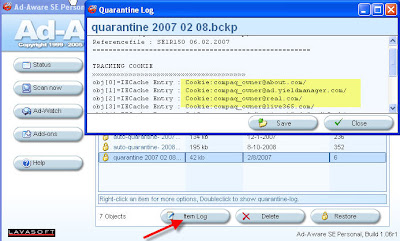
However: To keep users from accidentally deleting an important file or list (Let's face it, how many users really know what is safe to delete?) most of the programs store the information that they are "deleting" in a quarantine file, which is another nice way of saying, "You thought you deleted those files but we really backed them up so they can be retrieved later." Again let me say that Anti-Spyware programs are a GOOD thing, but there are some things most users don't realize, and the quarantine file is a biggest one. This is not a huge problem: the file is easily emptied and you can also tweak the program's settings to not store the files or to store them for a limited period of time. The problem is that many users won't know to change the settings or delete the file themselves. Many people may not even care, but for those of you who are concerned about your privacy, you should take the time to look into your particular program's settings, to see what is saved and what you can do about it. The only thing worse than being paranoid is having a false sense of security.

However: To keep users from accidentally deleting an important file or list (Let's face it, how many users really know what is safe to delete?) most of the programs store the information that they are "deleting" in a quarantine file, which is another nice way of saying, "You thought you deleted those files but we really backed them up so they can be retrieved later." Again let me say that Anti-Spyware programs are a GOOD thing, but there are some things most users don't realize, and the quarantine file is a biggest one. This is not a huge problem: the file is easily emptied and you can also tweak the program's settings to not store the files or to store them for a limited period of time. The problem is that many users won't know to change the settings or delete the file themselves. Many people may not even care, but for those of you who are concerned about your privacy, you should take the time to look into your particular program's settings, to see what is saved and what you can do about it. The only thing worse than being paranoid is having a false sense of security.
Sunday, August 3, 2008
Is Google Maps a Threat to Indvidual Privacy?
Privacy groups are keeping a watchful eye on Google as it posts pictures of thousands of homes on their Street View website which is accessed through Google Maps. While being able to drop in to 360 degree photographic view Times Square from a map on their site is pretty cool, many privacy groups have expressed concern about what this may mean to individual privacy. Since the Street View project started Google has been outfitting cars with special cameras and sending them to drive the streets of the world snapping pictures of everything in their path, and everything along side of it.
The cause for concern is that someone may unknowingly be photographed in a compromising position (no more mowing the front yard in the nude for me), or that a criminal may use the information to case you home before he breaks in. For the first concern, if you're doing something you shouldn't; don't do it in public dummy! Law enforcement in many parts of the world already has a much better system of cameras feeding real-time data to "the man". Of course that's a whole other story. As for the crooks casing you place, that seems like a valid concern. Nothing is seen in the photographs online that couldn't be seen from the street, but at least before Google Streets the bad guys had to go out and look around in person.
Currently the database of photographs boasts 51 cities in the US as well as parts of Italy and France. Britain and Australia are on the way later this year. The sole purpose of the campaign is to capture pictures of streets and landmarks, not the people in them, however you just can't take a picture of a busy street and not expect to catch a glimpse of a person or a car license plate. To allay concerns that someone in a photo may be identified or a license lumber tracked down, Google has created a system that blurs most recognizable faces and license plates.
Yes, I said most. No automated system is perfect so Google allows users to report inappropriate images from within the application, and may request to have their pictures taken down. Though I think the "Report Inappropriate Image" link could have been more prominent it is easily located by clicking the "Help" link. Also what about the individuals that have been photographed and don't know to look at the website to see if they want their photos removed. After reviewing the photos available on the site I think they can add quite a bit of value for navigation, landmarks have always been easier to remember than street names. Also the photos a good enough quality to see the neighbors house and read some street signs, there was not enough detail to zoom in on any windows and see inside a house.
In all I think the risk to individuals privacy is minimal since the photos are low resolution and not real-time. The danger I see is in the precedent that this might set. Once everyone gets used to cameras everywhere, it will get easier to slip more intrusions into our private lives. I guess the best question to ask is, does the public have a reasonable expectation of privacy when in public. Does spying on the drug dealer on the corner openly selling his wares in full view place your privacy in danger or protect you from the bad guys? I won't tell you how to answer these questions because everyones limits are different. But I hope my rambling will cause you to pause for a moment to decide just where your limits do lie.
The cause for concern is that someone may unknowingly be photographed in a compromising position (no more mowing the front yard in the nude for me), or that a criminal may use the information to case you home before he breaks in. For the first concern, if you're doing something you shouldn't; don't do it in public dummy! Law enforcement in many parts of the world already has a much better system of cameras feeding real-time data to "the man". Of course that's a whole other story. As for the crooks casing you place, that seems like a valid concern. Nothing is seen in the photographs online that couldn't be seen from the street, but at least before Google Streets the bad guys had to go out and look around in person.
Currently the database of photographs boasts 51 cities in the US as well as parts of Italy and France. Britain and Australia are on the way later this year. The sole purpose of the campaign is to capture pictures of streets and landmarks, not the people in them, however you just can't take a picture of a busy street and not expect to catch a glimpse of a person or a car license plate. To allay concerns that someone in a photo may be identified or a license lumber tracked down, Google has created a system that blurs most recognizable faces and license plates.
Yes, I said most. No automated system is perfect so Google allows users to report inappropriate images from within the application, and may request to have their pictures taken down. Though I think the "Report Inappropriate Image" link could have been more prominent it is easily located by clicking the "Help" link. Also what about the individuals that have been photographed and don't know to look at the website to see if they want their photos removed. After reviewing the photos available on the site I think they can add quite a bit of value for navigation, landmarks have always been easier to remember than street names. Also the photos a good enough quality to see the neighbors house and read some street signs, there was not enough detail to zoom in on any windows and see inside a house.
In all I think the risk to individuals privacy is minimal since the photos are low resolution and not real-time. The danger I see is in the precedent that this might set. Once everyone gets used to cameras everywhere, it will get easier to slip more intrusions into our private lives. I guess the best question to ask is, does the public have a reasonable expectation of privacy when in public. Does spying on the drug dealer on the corner openly selling his wares in full view place your privacy in danger or protect you from the bad guys? I won't tell you how to answer these questions because everyones limits are different. But I hope my rambling will cause you to pause for a moment to decide just where your limits do lie.
Sunday, July 27, 2008
G8 Threatens Privacy!
Here are a couple of important (read: terrifying) tidbits that came out of the G8 Justice and Home Affairs Ministerial Meeting held June 11-13, 2008.
The G8 is pushing for its member states to monitor Mobile and ISP traffic for copyrighted material to further a high level treaty called the Anti Counterfeiting Trade Agreement (ACTA) that they are working on. So not only will your ISP be spying on you (in the interest of fighting piracy of course) but so will your cell phone company!
I do not condone piracy, but this seems a little too Orwellian to me. Next thing you know the governments could be strong arming service providers of all types to listen for “potential terrorists” engaging in suspicious or anti government talk. Hello!?!? You may as well use the Constitution for toilet paper!
Additionally the G8 wants to give airport customs officials the right to scan portable media players for copyrighted material. Giving customs officials the power to scan MP3 players, laptops and even mobile phones for illegally-obtained copyrighted material when passengers pass through borders seems ridiculous to me. Most likely these pirated items would have come from the internet and have absolutely NOTHING to do with a person physically flying to another country. Ok, you want to look in my luggage to find the 30 Madonna CDs I burned at home and I plan to sell in Bangkok, fine, but what the hell am I going to have on my laptop that I couldn’t download sitting in a Starbucks anywhere In the world.
Of course the owners of a copyright need protection but not at the expense of personal freedom. There HAS to be a better way than having some jackbooted thug digitally violate you in the interest of protecting some rich bastard’s profit margin!
Note: The G8 Justice and Home Affairs Ministerial Meeting is a forum allowing the G8 (Japan, Italy, Canada, France, USA, UK, Russia, Germany) Ministers responsible for justice and home affairs, the EU Commissioner for Justice, Freedom and Security, and the Secretary-General of the International Criminal Police Organization (ICPO) to meet and discuss matters of common interest. From: http://www.g8jha2008.jp/eng/what.html
Sources
http://www.g8jha2008.jp/eng/what.html
http://www.switched.com/2008/07/20/airports-may-scan-for-illegal-downloads-on-mobile-devices/
http://www.newlaunches.com/archives/g8_acta_think_twice_before_you_share_protected_content.php
The G8 is pushing for its member states to monitor Mobile and ISP traffic for copyrighted material to further a high level treaty called the Anti Counterfeiting Trade Agreement (ACTA) that they are working on. So not only will your ISP be spying on you (in the interest of fighting piracy of course) but so will your cell phone company!
I do not condone piracy, but this seems a little too Orwellian to me. Next thing you know the governments could be strong arming service providers of all types to listen for “potential terrorists” engaging in suspicious or anti government talk. Hello!?!? You may as well use the Constitution for toilet paper!
Additionally the G8 wants to give airport customs officials the right to scan portable media players for copyrighted material. Giving customs officials the power to scan MP3 players, laptops and even mobile phones for illegally-obtained copyrighted material when passengers pass through borders seems ridiculous to me. Most likely these pirated items would have come from the internet and have absolutely NOTHING to do with a person physically flying to another country. Ok, you want to look in my luggage to find the 30 Madonna CDs I burned at home and I plan to sell in Bangkok, fine, but what the hell am I going to have on my laptop that I couldn’t download sitting in a Starbucks anywhere In the world.
Of course the owners of a copyright need protection but not at the expense of personal freedom. There HAS to be a better way than having some jackbooted thug digitally violate you in the interest of protecting some rich bastard’s profit margin!
Note: The G8 Justice and Home Affairs Ministerial Meeting is a forum allowing the G8 (Japan, Italy, Canada, France, USA, UK, Russia, Germany) Ministers responsible for justice and home affairs, the EU Commissioner for Justice, Freedom and Security, and the Secretary-General of the International Criminal Police Organization (ICPO) to meet and discuss matters of common interest. From: http://www.g8jha2008.jp/eng/what.html
Sources
http://www.g8jha2008.jp/eng/what.html
http://www.switched.com/2008/07/20/airports-may-scan-for-illegal-downloads-on-mobile-devices/
http://www.newlaunches.com/archives/g8_acta_think_twice_before_you_share_protected_content.php
Friday, February 2, 2007
social security number risk
Maybe it's just me but I would think with all the media coverage about the risk to peoples' personal information and identity theft, and the laws requiring due diligence in protecting your clients information that agencies and businesses would start taking greater care.
Here's an example; I saw a news report a few years ago about doctors and hospitals carelessly throwing old medical records in the trash, and not long after shredding of outdated or sensitive documents became much less a good idea and more a necessity!
Now here is my specific gripe. Have you ever noticed those handy little baskets full of mail at the receptionist's desk at the doctor's office, or your lawyer's? I mean come on!!! You would think the medical profession would have learned their lesson by now, and if you can't trust your ATTORNEY, of all people, with your information the world is in sad shape. After I noticed this trend I really started paying close attention. This practice is very commonplace, at least in the area where I live. Even better, not only is the mail, full of your personal and possibly damaging information, sitting on the front counter in easy reach of anyone off the street, but (no exaggeration) 90% of the time the was no one any where near the desk to even keep an eye on it!
At my local physician's office that nifty little mail basket sits on a counter full of fliers for patients to take home. Just the other day I sat and watched a seedy looking fellow browse through the pamphlets for a good 15 minutes. And NO ONE NOTICED! Why would they? He was just browsing through the material that the office, in all their wisdom, left for him to look at. The fact that he could have just as easily picked up the 3 inch stack of outgoing mail and walked off with it to examine at his leisure must have never crossed anyone's mind!
Tell me, am I just being paranoid? Or does somebody need a little training, and maybe an ass kicking!
One more gripe, this one just happened today! Okay it actually starts yesterday. I was at the county/state run employment agency and signing up for an orientation class. The guy handed me a sheet of paper and asked me to write my name and social. Above my name was at least five other names and socials. I mean this guy had filled my information in on at least 5 other forms on his PC, I guess he couldn't operate a pen. Or maybe he was just being nice and trying to give me a little extra help stealing someone else's identity. No harm done though, I guess he's such a good judge of character that he could just tell what an honest guy I am. My poor wife had to listen to me rant about this for 30 minutes.
Icing on the Cake
Today I went in for the aforementioned orientation meeting. This time another guy had that familiar little piece of paper so he could call role. No big deal I am sure he was authorized to have everyone social security numbers for other aspects of his job. However, the first part of the meeting was going to be a 15 min video that he'd already sat through hundreds of times so understandably he left the room while we watched it. The only problem was that he decided to leave that inconspicuous paper lying on a table right in front of one of the other meeting attendees. I mean it was like he sat it down FOR him to look at. Would it have killed him to take it out of the room with him, or at least put it up on top of the TV. For Pete's sake!!! This is a Government agency! No wonder bureaucrats have such a bad rap. I haven't decided yet if I should write an article for the newspaper, make a suggestion at that office, or call my friggin' congressman. Come on folks let me hear from you, I'm dying to know if I'm just being a paranoid nutball or what.
Here's an example; I saw a news report a few years ago about doctors and hospitals carelessly throwing old medical records in the trash, and not long after shredding of outdated or sensitive documents became much less a good idea and more a necessity!
Now here is my specific gripe. Have you ever noticed those handy little baskets full of mail at the receptionist's desk at the doctor's office, or your lawyer's? I mean come on!!! You would think the medical profession would have learned their lesson by now, and if you can't trust your ATTORNEY, of all people, with your information the world is in sad shape. After I noticed this trend I really started paying close attention. This practice is very commonplace, at least in the area where I live. Even better, not only is the mail, full of your personal and possibly damaging information, sitting on the front counter in easy reach of anyone off the street, but (no exaggeration) 90% of the time the was no one any where near the desk to even keep an eye on it!
At my local physician's office that nifty little mail basket sits on a counter full of fliers for patients to take home. Just the other day I sat and watched a seedy looking fellow browse through the pamphlets for a good 15 minutes. And NO ONE NOTICED! Why would they? He was just browsing through the material that the office, in all their wisdom, left for him to look at. The fact that he could have just as easily picked up the 3 inch stack of outgoing mail and walked off with it to examine at his leisure must have never crossed anyone's mind!
Tell me, am I just being paranoid? Or does somebody need a little training, and maybe an ass kicking!
One more gripe, this one just happened today! Okay it actually starts yesterday. I was at the county/state run employment agency and signing up for an orientation class. The guy handed me a sheet of paper and asked me to write my name and social. Above my name was at least five other names and socials. I mean this guy had filled my information in on at least 5 other forms on his PC, I guess he couldn't operate a pen. Or maybe he was just being nice and trying to give me a little extra help stealing someone else's identity. No harm done though, I guess he's such a good judge of character that he could just tell what an honest guy I am. My poor wife had to listen to me rant about this for 30 minutes.
Icing on the Cake
Today I went in for the aforementioned orientation meeting. This time another guy had that familiar little piece of paper so he could call role. No big deal I am sure he was authorized to have everyone social security numbers for other aspects of his job. However, the first part of the meeting was going to be a 15 min video that he'd already sat through hundreds of times so understandably he left the room while we watched it. The only problem was that he decided to leave that inconspicuous paper lying on a table right in front of one of the other meeting attendees. I mean it was like he sat it down FOR him to look at. Would it have killed him to take it out of the room with him, or at least put it up on top of the TV. For Pete's sake!!! This is a Government agency! No wonder bureaucrats have such a bad rap. I haven't decided yet if I should write an article for the newspaper, make a suggestion at that office, or call my friggin' congressman. Come on folks let me hear from you, I'm dying to know if I'm just being a paranoid nutball or what.
Subscribe to:
Posts (Atom)