Don't get me wrong I see the usefulness of this little gadget and accompanying app but I always see the spooky side of things, I guess. According to the FAQs at http://www.thetileapp.com the tile uses Bluetooth 4.0 and has a range of 50-150 ft. but as you can see from the video, if the app becomes ubiquitous you will be able to find your tile almost anywhere. Imagine this scenario: Stalker Sam has a crush on Lovely Linda but Linda doesn't want anything to do with Sam. Sam doesn't know how to take no for an answer and slips one of his Tiles in Linda's backpack. For good measure he slips several Tiles in other items belonging to Linda as well. One day Sam can't seem to locate Linda by the usual means so he activates his tiles and finds that she is at the local college campus and he goes hunting her there. After following her around for a while she notices she's being tailed and tries to lose him. Eventually thinking she has lost him she heads through the wooded area around the school on her way home but he's on her again. It's getting dark and she hides in the thick brush, luckily, she thinks, he keeps looking at his phone and the light gives away his location so she can keep just out of sight. That is until she starts hearing this loud beeping noise, and it's coming from her...
Saturday, August 3, 2013


Saturday, September 4, 2010
Friday, July 23, 2010
RFID Security Breech Credit Card
The tin foil hat brigade was onto something, just cut a piece of aluminum foil 3 to 4 times the height of your wallet then fold it to the appropriate size and put it in the bill compartment. To test it out place your wallet (must have an RFID equipped card inside) next to the appropriate type of scanner (credit card, bus pass. etc) if it beeps the foil isn't thick enough. If it doesnl't beep you should be ok.
Monday, April 19, 2010
Facial Recognition for Your (Stalker's) iPhone
Of course the makers of the application mentioned in the video state that only people you choose to allow can find you with their application but that doesn't take into account those of us who inadvertently leave privacy holes in our social networking. Nor does it take into account how good the bad guys really are at their jobs. Thankfully this app has not been released yet (I think, hope, pray) but I 'm sure it won't be long. Please take steps to secure your personal information and plug the holes in your social networking. Tips after the video.
- Be picky. Set your profiles so that only people you approve can view your details. If the social network that you're on does not allow this, find a different one.
- Unless you never ever add anyone that you don't know and trust personally be very selective about the information you put in your profile. See next.
- Think again about submitting your birthday. Sure it's nice to have all those messages from your friends (once they've been reminded of course), but aside from your social security and mothers maiden name, your birth date is one of the most often requested pieces of information that you are asked for when someone is trying to verify your identity. If the social network requires your birth date for age verification make sure you set it to not be displayed or lie.
- Unless you name is John Smith and you live in a city of 3 million avoid mentioning your home town or the town you currently live in. Remember that password hint question from when you signed up for that online email account? Why not just give identity thieves your password and get it over with quickly. Better yet always make up your own security question when given the opportunity.
- If you are using social networking for business and personal use, consider creating separate accounts, and keep them separate. If you've already mixed "business and pleasure" it's not too late. Create your business page now so you can all those new strangers without exposing all your personal information.
- Don't make your friends list public if you have the choice. Of course for most networks your friends are usually visible to each other no matter what.
- A picture is worth a thousand words. Think about what that innocent, yet very cool, picture of you sittin' on a Hog in front of your house might reveal about you. Time to break out the sharpie and cover up the license plate and your address on the front of your house. Oh, wait! Forget the sharpie, you'll never get that off the screen. Any photo/image editor should be able to do the trick, even MS Paint. Be on the lookout for other giveaways too, such as; street signs, political signs (supporting a local politician), school bumper stickers. Geeze being paranoid is a lot of work!
- Use a web based email provider like Yahoo! Hotmail, or Google. That email address your Internet Service Provider gave you tells people where you are, especially if it's one of the local guys.
Tuesday, April 6, 2010
Your Cellphone Might Be Spying on You
Cell phones have become such an integral part of our lives that many people would actually feel be wrought with anxiety if they left their cell phone at home, even for a short run to the store. However what many do not know is that the unobtrusive ever present convenience that you just can't live without may just be spying on you. Far from a conspiracy theory about some overbearing nanny state trying to keep tabs on its citizens, this is a reality. Instead of the government you your phone could be sending your every move to your jealous spouse, your parents, your boss, or even worse, someone who could mean you harm. Please watch the video below. This is real. Not just fear-mongering. Some useful tips below the video.
To help avoid this situation to begin with:
To help avoid this situation to begin with:
- You should never leave your phone unattended. It only takes a short time to install software, or your phone could be swapped for a clone.
- Password protect your phone. The default passwords for most phones are easily available on the Internet. More often than not it's the last four digits of your phone number.
- Use the same policies for email and web surfing on your phone that you use on your computer. DO NOT open suspicious emails or visit untrusted sites. The smarter phones get the more susceptible they are to the same types of attacks as your computer and until they start shipping cell phones with anti-virus software you're naked.
- Contact the police if you are being harassed or feel like you might be in danger.
- Turn off your phone when not in use and remove the battery.
- While your phone may be compromised do not use it for anything that may come back to bite you like mobile banking or contacting any of your creditors or utility companies.
- Don't provide your personal information over your cellphone. Like your Social Security number, address, or even your birth date.
- Don't divulge your location or travel plans, even a trip to the store. If someone is listening they may be waiting for you let slip that you will be away from home so they can break in.
- Consider resetting your phone to factory specs. You can take it in to the store where you bought it (usually) or find out how to do it yourself online. Just make sure that you wait until the police are done with it. They can't catch your bad guy if you erase the evidence.
- Do not try to "set up" the bad guy! No matter how tempting it would be to try and lure your stalker into the open, some things are better left to professionals, and this is one of them.
Saturday, March 27, 2010
Spokeo - The Latest Threat to Your Privacy
As I have warned before, be careful what you post in your Social Networking profiles such as Myspace or Facebook. Always avoid giving personal information such as birth date, middle name, address etc. Well, now there is a new information aggregator (search engine) that may put your online identity together with your offline life. Go to www.spokeo.com and do a quick search for your name. When I search for my own VERY common name the results showed My Facebook profile picture, my address, how many people lived in my home (along with links to their information), marital status, hobbies and offered my credit rating (for a fee). They were even so kind as to provide a Google Earth view of my house! I'm not sure if this is a good thing or a bad thing but Spokeo often gets erroneous results. It showed a completely unrelated person with the same last name living in my home.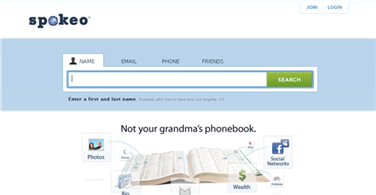
The good new is that you can have your information removed from Spokeo, though it doesn't have a nice big remove me button and it takes a little effort. One caveat: On the page where you remove your profile Spokeo touts the services of a company called ReputationDefender which will supposedly protect your privacy, for a fee, of course. Just follow the directions below.
Go to www.spokeo.com. Search for yourself. Once you have located your listing you will need to copy the URL that is in the browser's address bar (see picture). To copy the URL highlight it and press the "Ctrl" and "C" keys simultaneously. The screenshots below are from Mozilla Firefox but the steps are pretty similar regardless of which browser you are using.
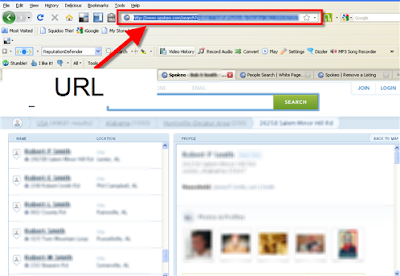
Look at the bottom of the page for the "Privacy" link and click on it . A new window (or tab) will open with an online form for you to fill out. Paste the URL into the appropriate field by clicking in it and pressing the "Ctrl" and "V" keys simultaneously. Next enter your email address and the "captcha" code, and click the button labeled "Remove Listing". It may take a few moments to process then the page will refresh with a statement to check your email. Supposedly there will be an email from Spokeo with further instructions, but since I still haven't gotten mine I can't provide much insight. Presumably there will be a link for you to click to confirm that you are who you say you are. Either that or I just got tricked into correlating my email address with my 'real world' information. Spooky!
One last tip though, if you don't see the email, check your spam folder for it. If you never get the email try this link http://www.spokeo.com/public/feedback and submit a request the old fashioned way.

The good new is that you can have your information removed from Spokeo, though it doesn't have a nice big remove me button and it takes a little effort. One caveat: On the page where you remove your profile Spokeo touts the services of a company called ReputationDefender which will supposedly protect your privacy, for a fee, of course. Just follow the directions below.
Go to www.spokeo.com. Search for yourself. Once you have located your listing you will need to copy the URL that is in the browser's address bar (see picture). To copy the URL highlight it and press the "Ctrl" and "C" keys simultaneously. The screenshots below are from Mozilla Firefox but the steps are pretty similar regardless of which browser you are using.

Look at the bottom of the page for the "Privacy" link and click on it . A new window (or tab) will open with an online form for you to fill out. Paste the URL into the appropriate field by clicking in it and pressing the "Ctrl" and "V" keys simultaneously. Next enter your email address and the "captcha" code, and click the button labeled "Remove Listing". It may take a few moments to process then the page will refresh with a statement to check your email. Supposedly there will be an email from Spokeo with further instructions, but since I still haven't gotten mine I can't provide much insight. Presumably there will be a link for you to click to confirm that you are who you say you are. Either that or I just got tricked into correlating my email address with my 'real world' information. Spooky!
One last tip though, if you don't see the email, check your spam folder for it. If you never get the email try this link http://www.spokeo.com/public/feedback and submit a request the old fashioned way.
Monday, December 7, 2009
Google Sidewiki - Potential for Abuse
Marketers are going to love this! Imagine being able to post information about your product on your competitions's website. I also think this is going to provide people with an ability to propogate disinformation about a product or company and it will show up right next to the victim's website. This could be a great tool as long as there is some control and the owner of a web site has a way to dispute a posting. While these concerns are somewhat addressed in the Content Policy let's hope that Google is able to make people adhere to the policy without becoming cost prohibitive or limiting free speech.
in reference to: Official Google Blog: Help and learn from others as you browse the web: Google Sidewiki (view on Google Sidewiki)Tuesday, October 27, 2009
Sunday, October 18, 2009
Tuesday, September 15, 2009
Military Recruiters Sharing Information About Your Kids Without Permission
The Department of Defense is maintaining a "Joint Advertising and Market Research Studies" Recruiting Database of over 30 million Americans between 16 and 25 years old. Huge exemptions to federal privacy laws leave it wide open for the DOD to disclose your kid's personal information without your permission! Go to the EPIC website for more information on the DOD Recruiting Database. If that's not enough, recruiters are at your child's school and recruiting your children without your permission. You have to opt out to keep them from actively recruiting your child. At my high school we had a recruiting station in one corner of the library with lots of pamphlets and brochures and once in a while a member of one of distinguished members of our Armed Services would be available to talk to any kid who was interested. I have absolutely no problem with that, What I do have a problem with is situations like the one described on MotherJones.Com. Where a young man was aggressively targeted by recruiters possessing information that he did not give them. I support all of our men and women in our Armed Forces and believe that military experience can be invaluable to many young people, but whatever happened to the old fashioned way of recruiting where interested kids sought out the recruiter? 2 of my own children have or are considering military service but I will be damned if I want some specially trained headhunter armed with insider information strong arming any of my kids into service. Remember, ours is a volunteer military.
Links
http://privacy.org/archives/003140.html
http://www.motherjones.com/politics/2009/09/few-good-kids
http://epic.org/privacy/student/doddatabase.html
Links
http://privacy.org/archives/003140.html
http://www.motherjones.com/politics/2009/09/few-good-kids
http://epic.org/privacy/student/doddatabase.html
Monday, September 14, 2009
Is Facebook Fan Check a Virus or a Hoax
There is currently a scare going around on Facebook and in emails stating that a Facebook application titled "Fan Check" is actually a virus that will activate after 48 hours even if you were tagged in a photo on someone else's profile. While the jury is still out on whether Fan Check is actually malicious, the greater risk comes from doing a search on the phrase '"Facebook Fan Check Virus" as you might be directed to a website containing fake antivirus software that will actually install a real virus or otherwise try to trick you out of your money. For an example of one of these sites watch the video below.
According to an article on Mashable the Fan Check app is most likely just a broken application that wont work because it violates Facebook's policies. Your safest bet is to stay away from Fan Check or any other application that claims that it can tell who's been viewing your profile, and definitely DO NOT search for “Fan Check Facebook virus”. If you are concerned that you have a virus or spyware scan your computer with trusted software. Do not install or scan your computer with any software that you are not familiar with or that you have not checked out thoroughly. Personally I use Spybot S&D, Adaware, and AVG Antivirus,
According to an article on Mashable the Fan Check app is most likely just a broken application that wont work because it violates Facebook's policies. Your safest bet is to stay away from Fan Check or any other application that claims that it can tell who's been viewing your profile, and definitely DO NOT search for “Fan Check Facebook virus”. If you are concerned that you have a virus or spyware scan your computer with trusted software. Do not install or scan your computer with any software that you are not familiar with or that you have not checked out thoroughly. Personally I use Spybot S&D, Adaware, and AVG Antivirus,
Saturday, September 12, 2009
GPS Tracking for Sex Offenders and Restraining Orders
What first seems like a common sense use for a valuable technology may in fact set a dangerous precedent for everyone. There are some who would like to use GPS technology to keep track of sex offenders and those who have had restraining orders placed upon them. In fact some states have already implemented this practice and more are likely to jump on the bandwagon. While I do not disagree with tracking of convicted felons as a condition of their parole, they are getting out early after all, I do feel that we should watch this trend very closely. By tracking offenders after their parole is up or individuals who have not been convicted of any crime as in the case of restraining orders, we are opening a door for the government to infringe on our privacy and civil liberties.
First let's consider how easy it is to get a restraining order in some states, and please keep in mind that each state has their own laws regarding restraining orders. Many a man going through a rough divorce has been barred from entering his own home or seeing his children based strictly on a statement by his wife that he has threatened her or the children. Perhaps this accusation is often true, but I am certain that this is not always the case. In some cases a restraining order may be enacted without any knowledge by the restrained person until he is served the order, meaning he may have never had any chance to refute the claims. Some restraining orders even have "relinquish firearms" provisions which means the subject has to turn any firearms and ammunition over to the authorities even though there may have been no crime.
Next lets consider the actual usefulness of tracking the individual. Individuals intent on doing bodily harm seldom let a restraining order stand in their way, hence the desire to track the individuals. The problem is, in my opinion, that GPS tracking will do very little to discourage violation of a restraining order by a determined individual. The tracking system would use a geo-fencing feature that could alert authorities if the 'offender' enters a restricted area, such as the victim's work place or neighborhood. However unless the 'victim' is also wearing a GPS tracker or carries a proximity alarm of some type the technology will only be helpful if the 'victim' is in one of the restricted areas. The record produce by the tracking system could prove useful as evidence in case the offender does violate the restraining order. Not much consolation to the victim perhaps, but it might help get a bad guy off the streets.
As with any technology GPS tracking can be used for good or bad we just need to be aware of the bad so we can make sure any laws that may pass contain provisions to protect law abiding citizens. I don't object to tracking someone who is a real threat to someone else but I think the threat should have to proven. A restraining order is not the same a criminal conviction where the accused has had the opportunity to provide a defense and face his accuser therefore they should not be able to infringe on any Constitutionally or God given rights.
In closing I think GPS may be appropriate for violent criminals on parole or out on bail and for individuals who have already violated a restraining order. GPS tracking is not appropriate in cases where there is no compelling evidence of a threat to the safety of the person requesting the order.
Links
Bill for GPS Tracking on Restraining Order Violations Could Head to State Legislature
A GPS Tracking System Could Assist with Restraining Orders
Wikipedia - Restraining order
Wednesday, August 19, 2009
Run a Background Check on Yourself Part 2
If you haven't already, check out my first article on how to Run a Background Check on Yourself. Go ahead I'll wait...
If you have ever wondered what information is available about you on the web and in public records I have found the perfect article for you Top 24 People Search Sites and Email Address Directories. While my previous article shows you how to get all the medical, credit, and insurance information available on you, the People Search Sites listed will show you what you have left behind online. Hopefully by now people are starting to wise up about where and how much information they put out into cyberspace, but it has been slow going. For example just consider how many people have been fired or denied employment for the things they post on their blog or Myspace account. While you may have control of deleting items you post to your accounts there is little or no control of what other people do with the information before you have deleted it, not to mention your information is likely to still be archived by thousands of search engines long after you have taken the information down. Your best safeguard is to think about everything you post before you post it, and remember that everything that you do post is permanent.
The next best thing if you really must post something that you are afraid will come back to haunt you is to post it under a pseudonym and do not link anything in your sensitive posts back to your true identity. This includes monetizing features like google adsense or adbrite. These may be linked back to you. Even creating a separate adsense or adbrite account may not help you if these accounts are linked back to your bank and tax ID.
Wednesday, August 5, 2009
Use Cash for Clunkers Website and Your Computer Belongs to the Government
The Cash for Clunkers program may seem enticing but as the old saying goes, "here is no free lunch". If you try to log in to the Cash for Clunkers website you have to agree to the privacy policy, which of course no-one ever reads... After agreeing to the privacy policy a warning box pops up telling you that your computer will become property of the government and anything stored on your computer can be retrieved and shared, even with foreign entities.
Check out the video below to see how the government is tricking people into letting them irrevocable access EVERYTHING on their personal computers.
Check out the video below to see how the government is tricking people into letting them irrevocable access EVERYTHING on their personal computers.
Whitehouse Wants You to Report Anyone Who Speaks Out Against Healthcare Reform
It's true. The government is requesting assistance from the public in quashing dissension from those evil right wing extremists (ie, anyone who disagrees)! Seriously. Check out this excerpt from the Whitehouse blog:
 Scary isn't it? Check out this link at RedState regarding the legality of this. White House Actions Might Be Unlawful
There is a lot of disinformation about health insurance reform out there, spanning from control of personal finances to end of life care. These rumors often travel just below the surface via chain emails or through casual conversation. Since we can’t keep track of all of them here at the White House, we’re asking for your help. If you get an email or see something on the web about health insurance reform that seems fishy, send it to flag@whitehouse.gov.And just in case public response forces the removal of the statement from the Whitehouse blog here is a screenshot for posterity.
 Scary isn't it? Check out this link at RedState regarding the legality of this. White House Actions Might Be Unlawful
Saturday, July 18, 2009
Chips Embeded in Official IDs Are a Huge Privacy Risk
For anyone who doesn't know, which is most of us, an RFID Chip is a tiny chip that can be embedded in virtually anything, from products in the grocery store to your bus pass and even people. You've probably seen the credit card commercial with the marathon runner that zips into a convenience store and pays for his purchase by merely holding his credit card close to the machine instead of sliding it through the machine the old fashioned way. Really convenient right? Well it's convenient for identity thieves too.
When this technology first came and out it wasn't wide spread an identity thief needed to get pretty close to the target to scan the chip and retrieve the information on it. This is no longer the case. As the technology has grown more prolific so have the profits in creating the gadgets that scan for it. As an example consider the experiment published in an article on the Fox News Website "Chips in Official IDs Raise Privacy Fears" in which a gentleman named Chris Paget cruised around Fisherman's Wharf in San Francisco, California scanning for the private information held on RFID tags of the crowds using a Matrics antenna and a Motorola reader that he bought on eBay for less than $250. In an hour he had 'skimmed' the private data from the new electronic U.S. passport cards of several individuals from as far away as 20 feet. Mr. Paget filmed his experiment and posted it to the Internet.
While the implementation of embedded RFID tags in government documents is not widespread yet there is a push from government officials to see it done quickly. Officials are touting safety and convenience of having you information easily accessible. Either they haven't bothered to think of the consequences or they just don't care because being able to track everything that you do fits there agenda. Thanks to the Real ID Act: h.r.00418 which was passed in 2005 without ANY debate, states must start issuing State IDs with and embedded RFID tag by 2017. The Real ID Act was pushed through by adding an amendment to a completely UNRELATED must pass bill to authorize funds for the Iraq war. This seems to be a common tactic in getting a controversial bill to pass that otherwise would not. In my humble opinion this practice is completely immoral and should be illegal, but I suppose that is the subject of another rant.
The Pass ID Act: S.1261 has recently been introduced before lawmakers which supposedly would repeal part of the Real ID Act as well as amend title II of the Homeland Security Act of 2002. However this bill does not protect citizens from identity theft or government abuses, in fact it may be a sneak attack to reinforce the Real ID Act. The Real ID Act needs to be repealed completely or by 2017 we will all be walking around with a tracking beacon in our pockets broadcasting our entire lives to anyone with the inclination to snoop, which includes alot of people and organizations. Just think of how much of your online activity is tracked by the government, retail websites, search engines, and marketing firms. Imagine how valuable a record of your real world travels, purchases, interests, and even health problems would be. To top off all this paranoia, it appears that two of the major backers of The Pass ID Act and previously the Real ID Act, the American Association of Motor Vehicle Administrators and the International Civil Aviation Organization, are INTERNATIONAL as in not USA organizations!
...and now for another paranoia inducing video
There may be other 'related' videos in the player above that may seem extremely paranoid. These videos are included by YouTube and do not necessarily reflect the views of this writer.
Eventually we will have one card (or pendant, wristband, or implant) that will contain all of our information and may even be used as currency. There are already pilot programs that allow users of already existing Real ID Cards to use them in lieu of their credit card. Now at the risk of sounding like a paranoid, end of the world, religious nut...
Aside from the above legislation we will never be completely free of RFID tags. RFID tags have many legitimate uses from inventory control to identifying lost pets. As mentioned above 'smart' passports and Real IDs are already in use. You will still need to take action to protect yourself from the common thief regardless of how you feel about the Real ID Act. There are several relatively inexpensive products on the market now that will shield your card/passport from being scanned such as the RFID Blocking Leather Passport Case and the Travelon RFID Blocking Billfold
 . Shoplifters have been blocking RFID for some time by using shopping bags lined with aluminum foil (don't get any ideas!). Here is an interesting artilcle on How to kill your RFID chip, of course when it comes to your passport you may not want to permanently destroy the chip rendering your passport void. Remember; tampering with a US passport is a federal offense. Of course any of the tags you find in items that you purchase are yours to do with as you wish.
For a partial list of companies that place RFID tags in their products check out Liz Michaels' website.
When this technology first came and out it wasn't wide spread an identity thief needed to get pretty close to the target to scan the chip and retrieve the information on it. This is no longer the case. As the technology has grown more prolific so have the profits in creating the gadgets that scan for it. As an example consider the experiment published in an article on the Fox News Website "Chips in Official IDs Raise Privacy Fears" in which a gentleman named Chris Paget cruised around Fisherman's Wharf in San Francisco, California scanning for the private information held on RFID tags of the crowds using a Matrics antenna and a Motorola reader that he bought on eBay for less than $250. In an hour he had 'skimmed' the private data from the new electronic U.S. passport cards of several individuals from as far away as 20 feet. Mr. Paget filmed his experiment and posted it to the Internet.
While the implementation of embedded RFID tags in government documents is not widespread yet there is a push from government officials to see it done quickly. Officials are touting safety and convenience of having you information easily accessible. Either they haven't bothered to think of the consequences or they just don't care because being able to track everything that you do fits there agenda. Thanks to the Real ID Act: h.r.00418 which was passed in 2005 without ANY debate, states must start issuing State IDs with and embedded RFID tag by 2017. The Real ID Act was pushed through by adding an amendment to a completely UNRELATED must pass bill to authorize funds for the Iraq war. This seems to be a common tactic in getting a controversial bill to pass that otherwise would not. In my humble opinion this practice is completely immoral and should be illegal, but I suppose that is the subject of another rant.
The Pass ID Act: S.1261 has recently been introduced before lawmakers which supposedly would repeal part of the Real ID Act as well as amend title II of the Homeland Security Act of 2002. However this bill does not protect citizens from identity theft or government abuses, in fact it may be a sneak attack to reinforce the Real ID Act. The Real ID Act needs to be repealed completely or by 2017 we will all be walking around with a tracking beacon in our pockets broadcasting our entire lives to anyone with the inclination to snoop, which includes alot of people and organizations. Just think of how much of your online activity is tracked by the government, retail websites, search engines, and marketing firms. Imagine how valuable a record of your real world travels, purchases, interests, and even health problems would be. To top off all this paranoia, it appears that two of the major backers of The Pass ID Act and previously the Real ID Act, the American Association of Motor Vehicle Administrators and the International Civil Aviation Organization, are INTERNATIONAL as in not USA organizations!
...and now for another paranoia inducing video
There may be other 'related' videos in the player above that may seem extremely paranoid. These videos are included by YouTube and do not necessarily reflect the views of this writer.
Eventually we will have one card (or pendant, wristband, or implant) that will contain all of our information and may even be used as currency. There are already pilot programs that allow users of already existing Real ID Cards to use them in lieu of their credit card. Now at the risk of sounding like a paranoid, end of the world, religious nut...
- Revelation 13:16 And he causeth all, both small and great, rich and poor, free and bond, to receive a mark in their right hand, or in their foreheads:
- Revelation 13:17 And that no man might buy or sell, save he that had the mark, or the name of the beast, or the number of his name.
Aside from the above legislation we will never be completely free of RFID tags. RFID tags have many legitimate uses from inventory control to identifying lost pets. As mentioned above 'smart' passports and Real IDs are already in use. You will still need to take action to protect yourself from the common thief regardless of how you feel about the Real ID Act. There are several relatively inexpensive products
on the market now that will shield your card/passport from being scanned such as the RFID Blocking Leather Passport Case and the Travelon RFID Blocking Billfold. Shoplifters have been blocking RFID for some time by using shopping bags lined with aluminum foil (don't get any ideas!). Here is an interesting artilcle on How to kill your RFID chip, of course when it comes to your passport you may not want to permanently destroy the chip rendering your passport void. Remember; tampering with a US passport is a federal offense. Of course any of the tags you find in items that you purchase are yours to do with as you wish.For a partial list of companies that place RFID tags in their products check out Liz Michaels' website.
Thursday, July 9, 2009
Social Networking Websites May Keep your Deleted Photos
Have you ever deleted a photo from a social networking website like Facebook or MySpace? Did you think that was the end of it? You might just be wrong. According to an article on BBC many of the websites take the easy way out. When you delete the photo from the website it appears to actually go away, such as when viewed from the photo album, however the file still exists on their servers until it is overwritten by other files.
A similar thing happens when deleting a file from your personal computer, the shortcut or link to the file goes away, according to the operating system anyway, however the file is still on your computer and easily retrievable using free software such as freeundelete. You don't even need to be a forensics expert. While this is great when you want to recover something you accidentally deleted it can become a problem if you want to get rid of something permanently. Your best bet is to use a file shredding or wiping utility. One of my favorites is Evidence Eliminator which I have tested myself. You can even download a free demo of Evidence Eliminator and test it yourself. Evidence Eliminator will overwrite your deleted files a number of times making it unretrievable. More on the use of file shredders later, for now please read the article on BBC: Websites 'keeping deleted photos'
A similar thing happens when deleting a file from your personal computer, the shortcut or link to the file goes away, according to the operating system anyway, however the file is still on your computer and easily retrievable using free software such as freeundelete. You don't even need to be a forensics expert. While this is great when you want to recover something you accidentally deleted it can become a problem if you want to get rid of something permanently. Your best bet is to use a file shredding or wiping utility. One of my favorites is Evidence Eliminator which I have tested myself. You can even download a free demo of Evidence Eliminator and test it yourself. Evidence Eliminator will overwrite your deleted files a number of times making it unretrievable. More on the use of file shredders later, for now please read the article on BBC: Websites 'keeping deleted photos'
Monday, April 20, 2009
Obama Administration Blames USA for 90 Percent of Guns Seized in Mexico
For once the News Media has stood up to Washington and called them on at least one of the exaggerations they are using to further their anti gun agenda! Hooray for Fox News!
I would like you to note that this story was aired on April 2, 2009 yet President Obama continues to propagate the lie. Check out this link, again by Fox News
Obama Repeats '90 Percent' Stat for U.S. Guns Recovered in Mexico - First 100 Days of Presidency - Politics FOXNews.com
According to Fox News the actual number of guns that could be attributed as coming from the US into Mexico in 2007 and 2008 is 5,114 and that's out of the 29,000 guns seized. That's only 17.6 percent! I think even a first grader could tell you that 5000 in two years is NOT equal to 2,000 guns a day as Secretary of State Hilary Clinton states.
I guess Obama and others like him, including Secretary of State Hillary Clinton, and US Senator Dianne Feinstein, figure that if they say it loud enough and often enough the American public will believe it and allow the 2nd Amendment to fade quietly into the night. Luckily, at least in this case, there are many who are questioning these statements, and for once it's not just the NRA. Just Google "90 percent guns Mexico" and you will see how many are standing up against this.
A huge problem with the media is that they are so eager to rush ahead with any information they get as soon as they get it in an effort to scoop the other guy that they often report erroneous information and rumors. Unfortunately the public in general trusts that the media has done their homework, and we believe the first reports we hear, which are also picked up by the other news agencies as soon as they are reported, and further disseminated until within one or two days everyone believes those first reports. More often than not if the truth comes out at all, it comes out later, with barely a whisper, usually after the event has ceased being 'news worthy'. If the story is cold enough the truth may never see the light of day. Take the Colombine School shooting 10 years ago. Up until this very day I like many other people believed that the two kids responsible were members of the 'Trench Coat Mafia' and were the victims of bullies. It turns out that this is not the case. This is just one example of disinformation that was rushed to print or broadcast in the heat of the moment, however when the dust settled and truth was discovered either it was under reported or the previous reports were already so entrenched into the public's minds that the truth just didn't sink in. Check out this article, Debunking the myths of Columbine, 10 years later.
Read Columbine, by Dave Cullen
Thursday, January 29, 2009
The British Want Their Guns Back - Don't Let This Happen to U.S.
Through complacency and a desire for security the British allowed their government to confiscate their guns. Now they want them back! The politicians in the United States know they have an uphill battle if they want to take our guns outright (kuz ev'ry one know us Americans luvs our guns) so we will lose our freedom in baby steps. No they won't come beat down our door and snatch up your guns (yet), but in small almost unnoticeable (and unreported by the media) ways we are losing our Constitutional RIGHT to bear arms.
These little restrictions come along with almost no fuss because we are complacent and it's almost always in the name of security or safety.
Like:
Register yourself and you weapon so the government knows you are a safe and responsible law abiding citizen (and so they know who has the guns when it's time to collect).
Or:
Lock your guns up in a safe so your kids can't get to them (neither can you) and require gun locks so even if you can get to your gun by the time you load it you're dead. Hasn't anyone ever heard of educating your children. Yes there's accidents but people fall off ladders and no one wants those locked away. And, Yes gun owners must behave responsibly and take measures to keep guns out of the wrong hands, but the government should not be telling us what to do in our own homes, period. How would such a law be enforced? Would law enforcement have the right to inspect your home for 'legal gun storage'? Can you see where this is going?
There will not be a sudden outright ban of all guns, Americans wouldn't settle for that. No first the will place more and more limits on who can own guns, what guns you can have (umm Brady Bill anyone), how much ammunition you may keep, how you store you firearms, require you to have a license. They will make it increasingly difficult to own a gun thereby decreasing the number of LEGAL gun owners until there are to few to stand up and fight (figuratively speaking of course). Don't wait until it's too late. Take notice of the laws YOUR elected officials are trying to pass and don't buy into the "it's for your safety" bull crap. Be knowledgeable and be ACTIVE in protecting your freedom. Without the right to bear arms their will be no freedom of religion, no freedom of speech, no right to assembly or any other freedoms that we as Americans enjoy. It's not so much what your government is that you need to protect yourself from but what your children's government could become. Watch the video above, and see where we could be in a few years if we allow it.
Tuesday, January 13, 2009
Free Temporary Disposable Email Address
Have you ever had to "Sign Up" or "Create an Account" in order to use some online service, access a website, or view a video, only to later find your email inbox full of junk from a site that you only planned to use once? Now you can get a free temporary disposable email address and use it to sign up. Don't use your personal email to sign up for some "free membership" that you will never use again. Check out GuerrillaMail.com to get a free temporary disposable email address. After you've gotten your disposable email address, go back to the website that requires you to "Sign Up" and use your new temporary email address. If the website sends you a confirmation email it can be retrieved from GuerrillaMail.com allowing you to complete the process. The email address will only exist for 15 minutes and then it's gone forever along with any unwanted emails from the offending site. The sweet thing about GuerrillaMail.com is that you don't have to go through the long sign up process that the other free providers require, and you never have to divulge your private information!
If for some reason you need a throwaway email account that lasts longer than 15 minutes such as the examples of my previous post: Hide Your Identity With a Pseudonym and Free Email Accounts use one of the free email providers such as Yahoo and Hotmail to set up throwaway email accounts.
No more Spam! - Guerrillamail.com
Subscribe to:
Posts (Atom)